


15 Jul Designed to Last: How Circular Thinking Is Reshaping Industrial Product Design
Modular housings, digital product passports, repair-friendly construction: sustainability is becoming a structural design decision, not a marketing claim. There is a question that industrial designers have rarely had to answer in quite this way before: how does this product end? Not how does it fail, or how does it get thrown away — but how does it come apart, cleanly, completely, in a way that allows its materials to re-enter the world as something useful rather than something discarded?
That question is now central to professional product design in 2026. And it is being driven not only by shifting values, but by hard regulatory deadlines.
From Voluntary to Mandatory
The EU’s Circular Economy Action Plan, now entering active enforcement, has moved sustainability from a brand aspiration to a legal requirement for many product categories. Manufacturers placing goods on the EU market must increasingly demonstrate that their products are durable, repairable, recyclable, and environmentally transparent — and they must prove it with data.
Central to this is the Digital Product Passport (DPP), introduced under the EU’s Ecodesign for Sustainable Products Regulation. Each DPP is a structured digital record linked to a unique product identifier, covering material composition, carbon footprint, repair instructions, disassembly guidance, and end-of-life routing. Without a valid DPP linked to the EU central registry — slated for operational launch by July 2026 — products in affected categories will face barriers to entering the single market. Battery passport requirements are already entering phased enforcement, with textiles, electronics, and construction products following.
For Swiss companies exporting to EU markets, this is not a distant concern. It is an active compliance horizon.
What Circular Design Actually Requires
Circular design sounds straightforward in principle. In practice, it demands a fundamental rethinking of how products are assembled, not just what they are made of. According to Eckstein Design, a Munich-based industrial design studio with deep expertise in capital goods and medical technology, circular design in 2026 means: materials must be separable by type, components must be easy to disassemble, and products must be optimised for refurbishment, second-life use, or take-back schemes.
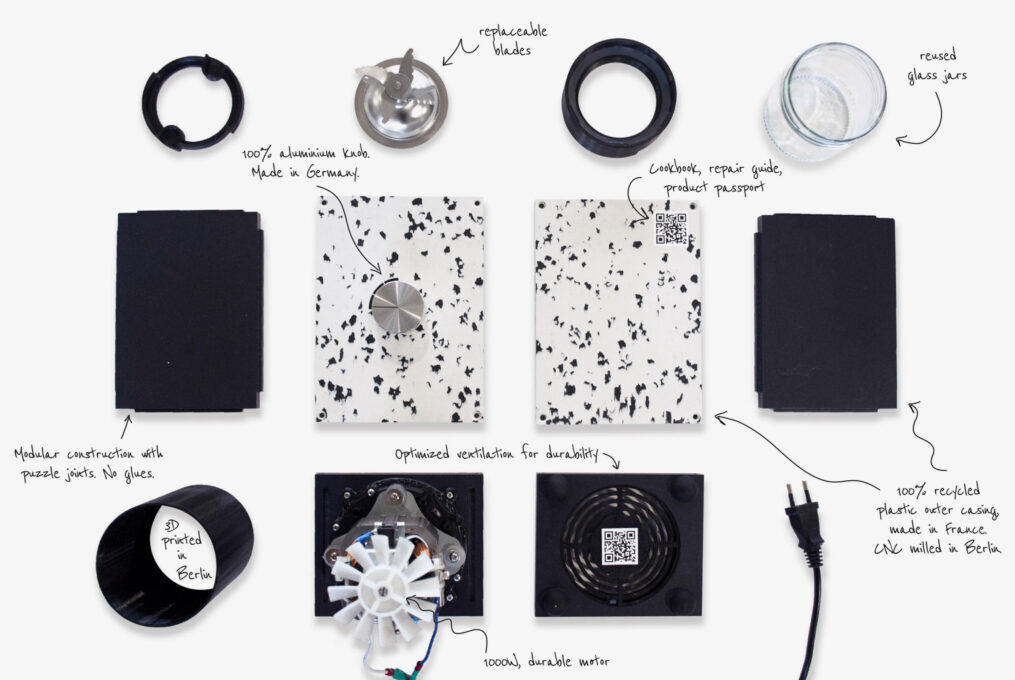
In practical terms, this translates to modular, screw-fastened housings instead of glued ones; durable and repairable constructions; deliberately selected materials with documented recycled content; and CO₂-reduced manufacturing processes. The logic is not only ecological — it is economic. Products designed to be repaired and refurbished generate ongoing service revenue. Products designed to be disassembled recover material value at end of life. The lifecycle cost argument for circular design is becoming as compelling as the regulatory one.
The Design Passport as a New Design Brief
The Digital Product Passport is more than a compliance tool. It is, in a meaningful sense, a new kind of design brief. Because the DPP must document repair and disassembly guidance, circularity information, and material composition throughout a product’s entire life, it forces design teams to think across the full lifecycle from the very beginning of development — not as an afterthought.
The DPP is also dynamic: it can be updated to reflect repair, refurbishment, resale, or recycling, helping preserve product value and reduce information loss across lifecycles. Think of it less as a label and more as a living record that travels with the product through every stage of its life. For designers, this means their decisions about material choices, joinery, and component modularity leave a permanent, traceable record. That is a significant professional responsibility — and a significant creative opportunity.
Beyond Compliance: Familiarity as a Design Value
RKS Design, a California-based product design firm, offers an interesting complementary angle. They observe that as products become more intelligent and complex, the most trusted ones are those that communicate their function through form itself — through material behaviour, tactility, weight, and physical feedback — rather than through screens, dashboards, and prompts. In this view, circular design and intuitive design converge: products that are honest about what they are made of, how they work, and how they can be repaired are also products that users can understand and trust.
Sustainability, in this framing, is not a layer added on top of good design. It is part of what good design means.
Our Take
The shift toward circular industrial design is one of the most substantive changes happening in the design professions right now — precisely because it is not primarily driven by aesthetics or trend cycles, but by regulation, material science, and genuine environmental urgency. For designers, this is both a constraint and an invitation: a constraint because the rules are real and the deadlines are approaching; an invitation because designing for longevity, repairability, and honest material use opens up a richer, more interesting design vocabulary than “make it look good and ship it.” The question “how does this come apart?” turns out to be one of the most generative questions a designer can ask.
Sources:
Further reading:
- Eckstein Design – Top 6 Industrial Design Trends for 2026
- RKS Design – 2026 Industrial Design Trends Shaping Products
- Reconomy – EU Digital Product Passports: A Business Guide
- TracexTech – Circular Economy Action Plan (CEAP): EU’s Blueprint
- DigiProdPass – The Ultimate Guide to Digital Product Passports (DPP)
- European Commission – Circular Economy Strategy
Photo: Open Funk Re:Mix blender, shortlisted in the sustainable design category Dezeen Awards (Edited by Dezeen)
AI Information: We have worked with the AI assistant Claude, who helped us with the research, structuring and content development for this article. All AI-generated content has been carefully reviewed and adjusted to ensure it reflects our understanding and expertise. Although the AI assisted us, we take full responsibility for the content of this article and its accuracy.
Sorry, the comment form is closed at this time.