


09 Jun Against the Algorithm: Why Designers Are Cutting, Collaging and Going Analogue in 2026
Something interesting is happening in graphic design studios right now. At the very moment AI tools can generate a flawless, beautifully composed visual in seconds, a growing number of designers are reaching for something else entirely: scissors, old magazines, grainy textures, mismatched fonts, and torn paper edges. Not because they can’t use the technology — but precisely because they can.
Adobe’s 2024 Creative Trends Report recorded a 30 percent rise in searches for hand-drawn and imperfect design elements, even as AI adoption accelerated. The more automated and polished the visual baseline becomes, the more deliberately human imperfection stands out.
Why Now?
In an era where AI can generate flawless visuals in seconds, imperfection becomes the new luxury — proof that a human made it. This tension is driving two of the most talked-about aesthetics in graphic design this year: the Punk Revival and the Scissorworks movement.
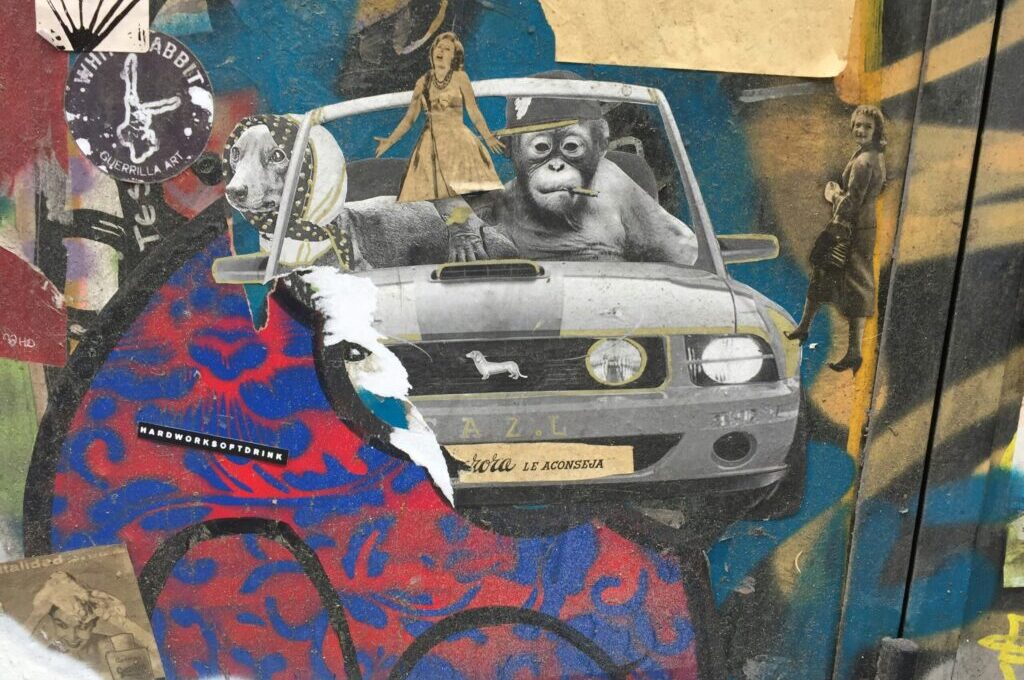
The Punk Revival draws its energy from 1970s zine culture — photocopied, cut-up, raw. Its new iteration is fuelled by Gen Z’s countercultural energy and a deep mistrust of corporate sameness. You recognise it immediately: distressed typography, collage layouts with irregular alignments, grainy textures, torn edges, and limited palettes built around black, white, and the occasional acid green or neon red. The message is clear — someone made this, and they didn’t care if it looked clean.
Scissorworks takes a similar impulse in a more narrative direction, bringing hand-done collage back into the spotlight as a renaissance of analogue expression, leaning into imperfection and depth through found artwork, imperfect cut edges, and archaic imagery.
The Bigger Picture
These aren’t just aesthetic trends. They reflect a genuine cultural shift. Much of today’s creative design is indexing more heavily on organic, analog, realistic, human-centered design — a response to what some in the industry are calling “AI fatigue.” When everything looks like it was generated, the things that clearly weren’t become remarkable.
A third aesthetic, Naive Design, extends this logic further, celebrating simplicity, childlike honesty, and emotional warmth expressed through irregular lines, uneven shapes, and spontaneous colour palettes — drawing inspiration from folk art, early computer graphics, and kindergarten drawings.
What these movements share is a desire to make design feel felt, not merely executed. Texture, roughness, and visible process are no longer signs of a rushed job. They’re intentional signals of authorship.
What This Means in Practice
For designers and studios, this creates both an opportunity and a challenge. The opportunity: work that carries a clear human signature will increasingly stand out in a sea of AI-generated content. The challenge: analogue aesthetics require real creative judgment. Chaos without intent just looks like a mess. The skill is in knowing how far to push the rawness before it stops communicating.
These trends are already showing up across music branding, fashion campaigns, editorial design, packaging, and — increasingly — in digital contexts like social media and web interfaces, where the rough-edged look creates a deliberate contrast with the surrounding polish.
Our Take
There is something almost poetic about the fact that the rise of AI in design has produced, as one of its most visible reactions, a renewed love for the handmade and the imperfect. It suggests that people still want to sense a human on the other side of a design — someone who chose, and felt, and made something. In 2026, the most interesting graphic design isn’t necessarily the most refined. Sometimes it’s the one that looks like it came from a kitchen table with a pile of old magazines and a very strong opinion.
Sources:
Read more:
Photo: Hannes Richter auf Unsplash
AI Information: We have worked with the AI assistant Claude, who helped us with the research, structuring and content development for this article. All AI-generated content has been carefully reviewed and adjusted to ensure it reflects our understanding and expertise. Although the AI assisted us, we take full responsibility for the content of this article and its accuracy.
Sorry, the comment form is closed at this time.